

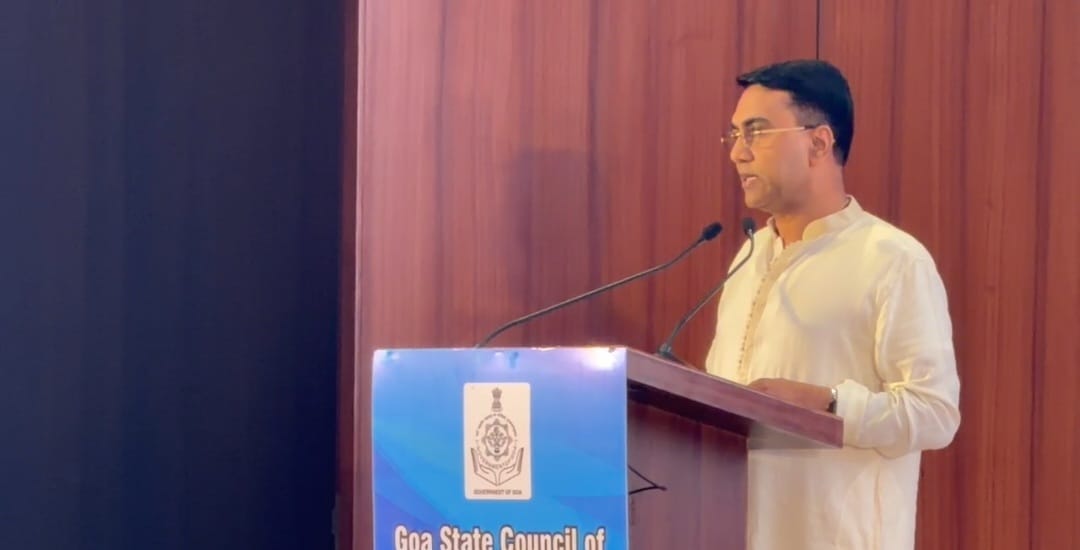
Panaji: Chief Minister Pramod Sawant on Wednesday said the recent student agitation over the NEET examination in the coastal state had “stooped to the lowest intellectual level”, alleging that the display of placards demanding the release of Umar Khalid had diverted the protest from its original purpose.
Addressing the inaugural session of the Goa Shiksha Samagam 2026 at Lok Bhavan, Dona Paula, Sawant said students have every democratic right to protest, but maintained that the conduct and messaging witnessed during the agitation could not be associated with genuine student movements.
“Students definitely have the right to protest. I can understand an agitation over NEET. But the kind of acts, thoughts, and language displayed during the agitation cannot be of students. Many of us have participated in student agitations in the past, but nobody stooped to such a low intellectual level,” he said.
The Chief Minister questioned why the issue of Umar Khalid was raised during a protest centred on NEET.
“I can understand the agitation over NEET. Union Education Minister Dharmendra Pradhan has acted in the interest of students and the nation. But who is Umar Khalid? Why should placards demanding his release be displayed during a NEET protest?” Sawant asked.
He further questioned how placards seeking Khalid’s release were displayed at Goa’s Azad Maidan, saying Khalid was arrested in connection with the Delhi riots cases.
“Who are these people? We need to awaken our students; otherwise, such developments will disturb communal harmony,” the Chief Minister said.
Sawant also alleged that people from outside Goa had been brought in to participate in the agitation and urged the public to examine videos of the protest.
Referring to the National Education Policy (NEP), he said its objective was to create culturally rooted and nationalist students capable of shaping their own careers and making independent decisions about their future.
Sawant said the NEP, which completed six years on Wednesday, replaced an education policy that had remained unchanged for 35 years.
“The policy was changed after 35 years, and it took six years to understand how to implement it. For the last 40 years, we were repeating the same pattern of education,” he said.
The Chief Minister said while some sections opposed the introduction of the new education policy, Goa is now recognised nationally for its implementation.
“There were some elements that opposed the NEP, but the case in Goa was different. Today, Goa is leading the country in the implementation of the National Education Policy. Whenever I attend national programmes, I feel proud that Goa is the leader,” he said.
Sawant said the state government sought the expertise of premier institutions such as the Indian Institute of Technology (IIT), National Institute of Technology (NIT), and Birla Institute of Technology and Science, Pilani, to effectively implement the policy.
Highlighting the objectives of the NEP, he said education should not be limited to obtaining degrees but should prepare students to succeed in life.
“Many students study only to get a degree. If you want to succeed in life, education must also include life skills so that students can decide their future,” he said.
Sawant said career guidance and skill development should begin at the school level, particularly from Class 8, enabling students to identify their interests and strengths early.
“We need to identify creativity and critical thinking among students from the basic education stage so that they can choose the right career path,” he added.
Referring to the growing use of artificial intelligence, the Chief Minister dismissed concerns that technology would replace teachers.
“Many fear that technology, especially artificial intelligence, will replace teachers. But technology can never replace teachers. It can only upgrade them. We need to use technology to improve teaching and learning,” Sawant said.

