

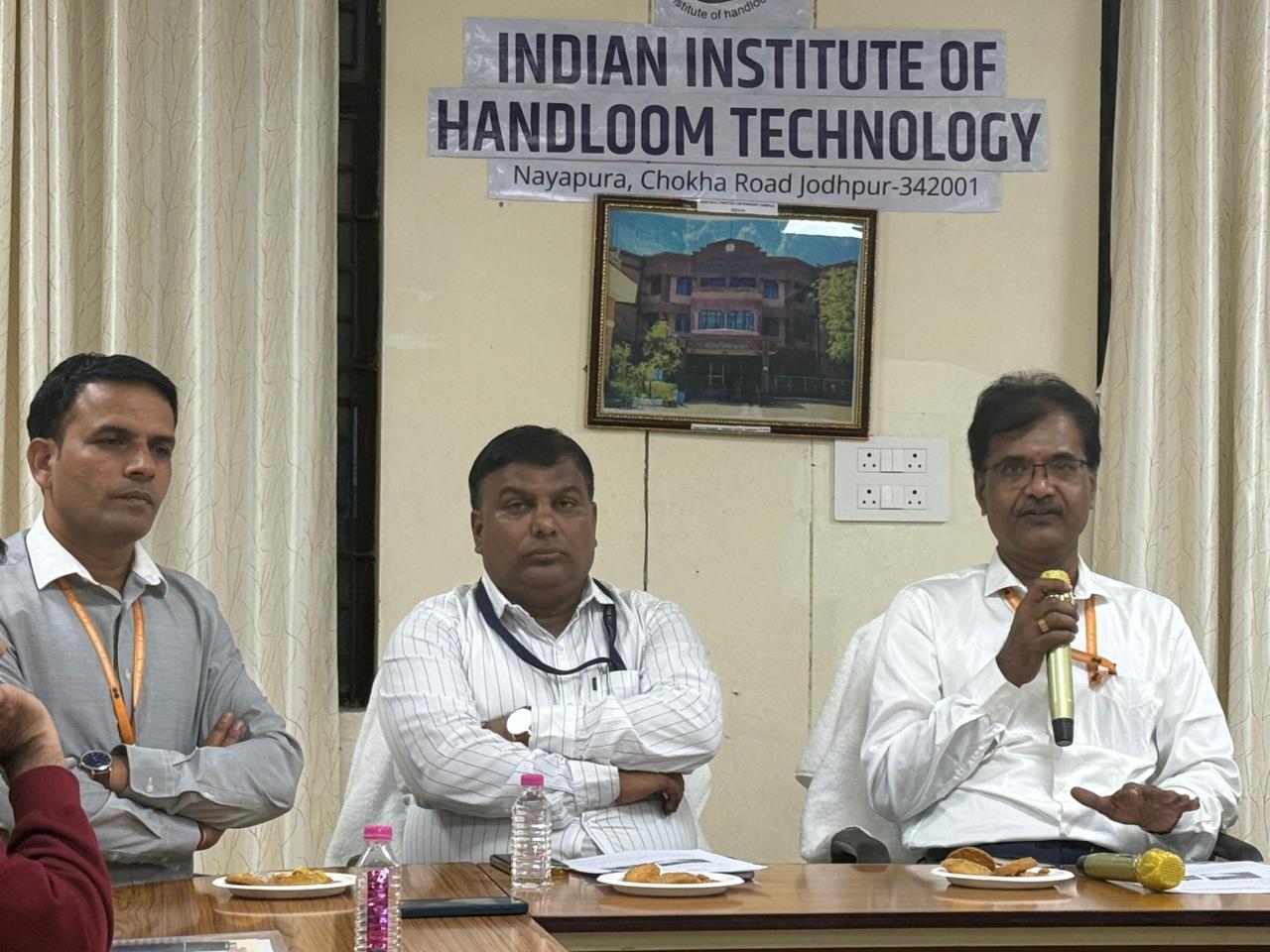
Jodhpur (Rajasthan): As India’s fashion industry continues to grow at a rapid pace, the country’s handloom sector is preparing to keep up — by empowering and training a new generation of young weavers.
The Indian Institute of Handloom Technology (IIHT), Jodhpur, has taken up the responsibility of ensuring that the age-old handloom industry not only survives but thrives despite the challenges it faces.
Dr. Sivagnanam K. J., Director of IIHT Jodhpur, told reporters that while the fashion industry in India is expanding swiftly, the handloom sector must also maintain its position in this fast-changing landscape.
He noted that although the handloom tradition has been passed down for generations, institutes like IIHT have been providing essential support to weavers — yet a stronger push is still required to sustain the sector’s relevance.
Since its inception, IIHT Jodhpur has trained 1,062 students, many of whom are now successfully employed in various organizations or have become entrepreneurs by setting up their own businesses. The students have secured jobs in the textile and allied industries across Punjab, Rajasthan, Himachal Pradesh, and Madhya Pradesh.
Dr. Sivagnanam said the main focus of the institution is to ensure that weaving continues as a family tradition among existing weaver households. To promote this, the institute reserves 20 per cent of its admissions for children from the weaver community. It has also launched outreach programs to encourage more youth from weaver families to pursue training in the field.
Located about 10 km from Jodhpur city, the IIHT campus offers hostel facilities that attract students from across India.
Highlighting the scale of the industry, Dr. Sivagnanam stated that while India has more than 28 lakh weavers, the greatest challenge lies in reaching this largely unorganised sector — with 85 per cent of weavers based in rural areas.
He explained that the courses offered at IIHT not only provide technical training in weaving but also help students understand market linkages and the business aspects of the trade.
Dr. Sivagnanam emphasised that the handloom sector, being an integral part of the fashion industry, must anticipate future design and colour trends.
“The handloom that you weave today is not for today — it must be created keeping in mind the trends of the next six months,” he said.
He added that the institute trains its students to be future-ready, equipping them with both traditional craftsmanship and modern industry knowledge.

