

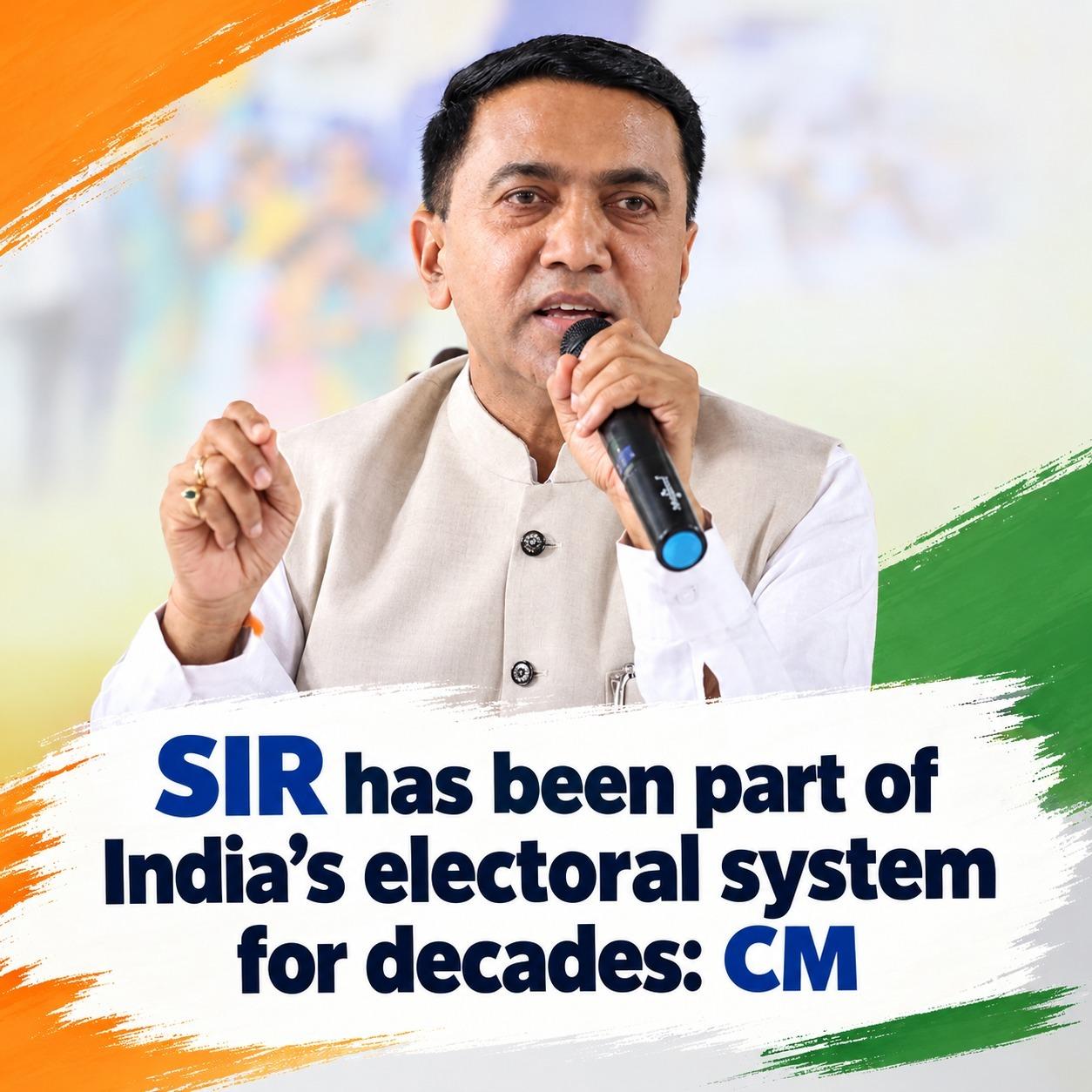
Panaji: Chief Minister Pramod Sawant on Tuesday said that the Special Intensive Revision (SIR) of electoral rolls was not a new process and had been part of India’s electoral system for decades.
In a post on X, Sawant said that intensive revision of electoral rolls had been undertaken several times since Independence, including in 1952-56, 1957, 1961, 1965, 1966, 1983-84, 1987-89, 1992, 1993, 1995, 2002, 2003 and 2004.
“Special Intensive Revision (SIR) is not a new process. Deep revision, or Intensive Revision, of electoral rolls has been part of India’s electoral system for decades,” he said.
Sawant said that these exercises involved door-to-door verification, distribution and collection of enumeration forms, and verification of voter records, and were carried out under different Chief Election Commissioners and governments over the past seven decades.
Explaining the need for such revisions, the Chief Minister said that rapid urbanisation and migration continuously change electoral rolls.
“New voters attain the age of 18, people pass away, voters shift residence, and instances of registration at more than one place may arise,” he said.
He said that periodic intensive verification helps keep electoral rolls accurate and updated.
“The objective is simple and fundamental to a healthy democracy: Every eligible citizen should be on the electoral roll, and no eligible voter should be left out,” Sawant said.
He described the ongoing SIR as “the next step in this long-standing electoral process”.
The Election Commission has been undertaking the SIR of electoral rolls in several states, with the exercise involving verification of existing voter records and claims and objections regarding the draft rolls.

