

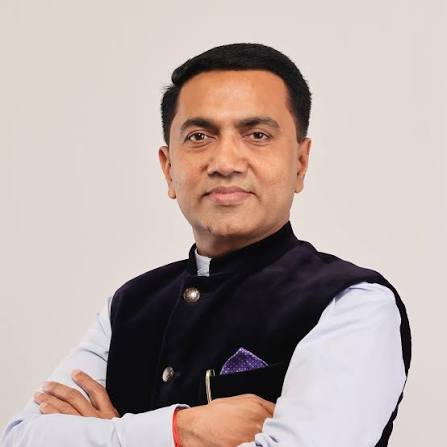
Panaji: Goa Chief Minister Pramod Sawant on Friday said the state aspires to become India’s “living laboratory of sustainable architecture”, where heritage conservation, climate resilience, and technology evolve together, while stressing that architects today must act as environmental leaders in the fight against climate change.
Addressing the National Conference on Goan Architecture and Sustainability in New Delhi, Sawant said climate change has fundamentally transformed the role of architecture, making every design decision critical to energy consumption, carbon emissions, and ecological resilience.
Gajendra Singh Shekhawat, Union Minister for Tourism and Culture, and Sadanand Shet Tanavade, Rajya Sabha MP, were present at the conference.
“Today, architects are not merely designers. They are environmental leaders,” he said, adding that Goa’s coastline, biodiversity, and fragile ecosystems require architecture that is intelligent, resilient, and environmentally responsible.
The Chief Minister said discussions on green buildings, climate-smart materials, and sustainable construction were no longer merely academic but had become policy priorities.
Highlighting Goa’s architectural heritage, Sawant said the state possesses centuries of accumulated wisdom in the use of climate-responsive building materials.
He said that long before concepts such as embodied carbon and sustainable supply chains entered global discourse, Goan architecture relied on locally available laterite stone, lime plaster, timber, and clay tiles that naturally suited the state’s tropical climate.
“These materials were selected because they responded naturally to Goa’s tropical climate, reduced heat absorption, allowed buildings to breathe, and blended harmoniously with the surrounding landscape,” he said.
Sawant said modern science is now validating practices that traditional Goan builders had followed instinctively for generations.
At the same time, he stressed that preserving tradition should not mean resisting innovation.
“New technology is not a competitor to our heritage; it can become its greatest ally,” he said, citing tools such as Building Information Modelling (BIM), artificial intelligence, digital documentation, laser scanning, material analytics, GIS mapping, and climate simulation as technologies that can help integrate traditional architectural knowledge with contemporary engineering.
Outlining the state’s vision, Sawant said Goa may be one of India’s smallest states, but “the greatness of ideas is never determined by geography”.
“Our aspiration is simple. We want Goa to become India’s living laboratory of sustainable architecture—a place where heritage conservation, climate resilience, technology, and public infrastructure grow together; where traditional wisdom guides future innovation; and where the world comes not only to admire Goa’s beauty but also to learn from Goa’s experience,” he said.

