

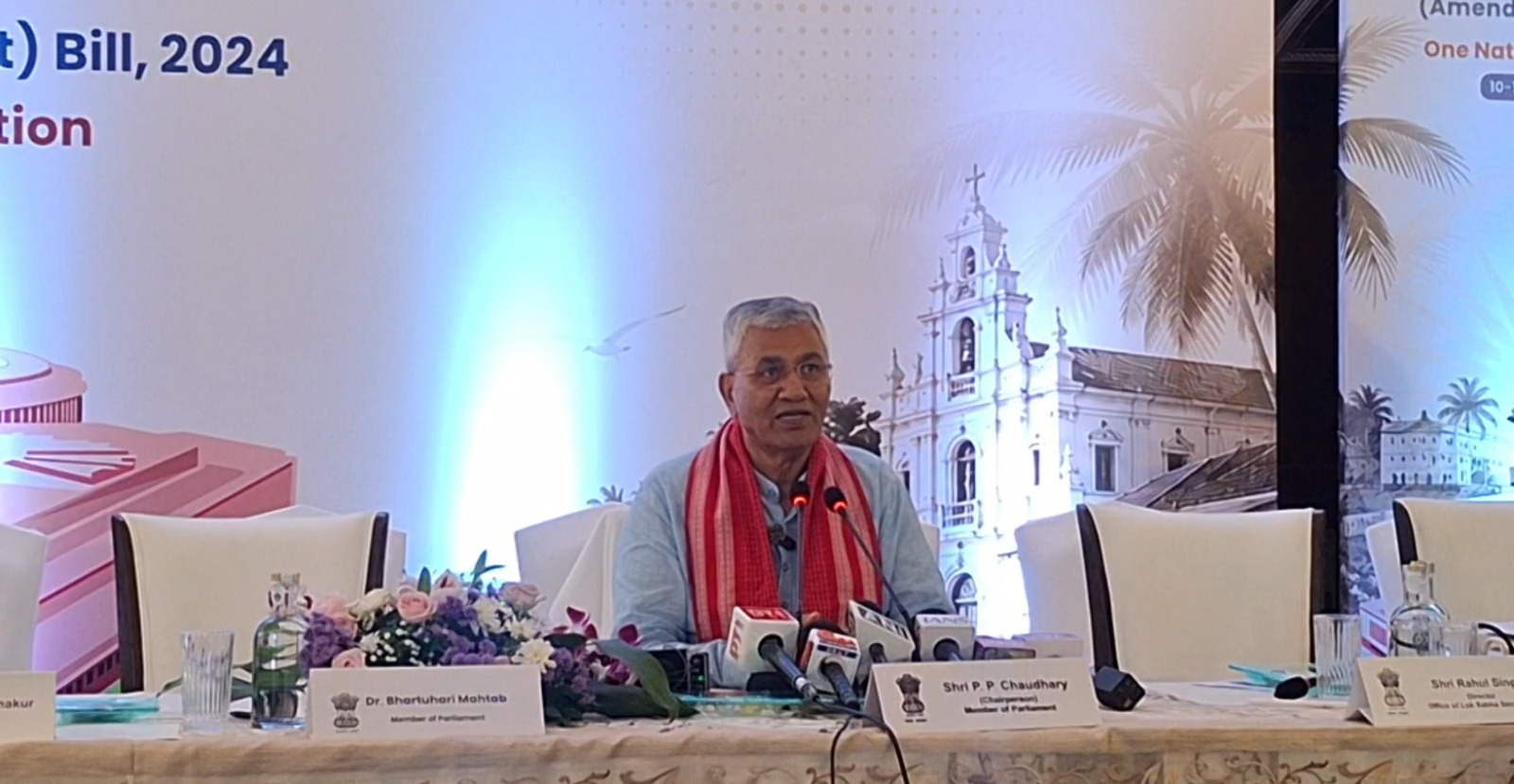
Panaji: The proposed ‘One Nation, One Election’ (ONOE) framework is fully consistent with the Constitution and does not violate India’s federal structure or democratic principles, Joint Parliamentary Committee (JPC) Chairman P. P. Chaudhary said on Saturday, citing the views of former Chief Justices of India and constitutional experts consulted by the panel.
Addressing a press conference at the end of the JPC’s two-day visit to Goa, Chaudhary said the committee had made it a priority to examine concerns over whether simultaneous Lok Sabha and Assembly elections would undermine federalism or the Constitution’s basic structure.
“When the committee started its work, the first question before us was whether simultaneous elections are against the Constitution, against federalism, or against democracy. We sought the opinion of legal experts, including six former Chief Justices of India. All of them independently told the committee that simultaneous elections do not violate the federal structure, democracy, or the basic structure of the Constitution,” he said.
He said three Supreme Court judges, the Chairman of the Law Commission, and several constitutional experts also conveyed similar views before the committee.
“The consensus among constitutional experts is that simultaneous elections are fully in consonance with the Constitution and are not inconsistent with any constitutional provision,” Chaudhary said.
The BJP leader said the committee had also consulted economists to assess the financial implications of holding simultaneous elections.
Referring to the report of the high-level committee headed by former President Ram Nath Kovind, he claimed that synchronised Lok Sabha and Assembly polls could add nearly Rs 7 lakh crore to the country’s economy by reducing election-related disruptions and improving governance.
He said frequent elections adversely affect education, tourism, industry, and production.
“Teachers in government schools are repeatedly deployed for election duties, affecting education. Tourist destinations such as Goa suffer losses because elections and the Model Code of Conduct disrupt tourism activity. Around five crore migrant workers move during election periods, affecting industrial production,” he said.
According to Chaudhary, industries also face financial stress during election-related disruptions, impacting production, loan repayments, and the banking sector.
He said simultaneous elections would provide governments with an uninterrupted five-year governance cycle instead of keeping the country in “continuous election mode”.
Tracing the history of simultaneous elections, Chaudhary said Lok Sabha and Assembly polls were held together between 1952 and 1967.
He said the election cycle was disrupted later due to the premature dissolution of Assemblies, changes in political leadership, the Emergency, and the repeated imposition of President’s Rule in several states.
“Today, five to six Assembly elections are held every year, keeping the country in election mode almost throughout the year,” he said.
Chaudhary said the Election Commission, in its 1983 report, the National Commission to Review the Working of the Constitution, the Law Commission, and several expert committees had recommended simultaneous elections in the national interest.
He also said the committee had travelled to several states, including Maharashtra, Uttarakhand, Punjab, Himachal Pradesh, Haryana, Karnataka, Gujarat, and Goa, to gather views from chief ministers, Speakers, legislators, civil servants, industry representatives, civil society organisations, and the media.
“The committee has received valuable suggestions from stakeholders across the country. These will be considered while preparing our report. The objective is to evolve a law that serves the national interest for decades to come,” he said.
Chaudhary maintained that simultaneous elections would reduce public expenditure, improve governance, minimise inconvenience to citizens, and strengthen economic growth without compromising the constitutional scheme or the federal character of the country.

