

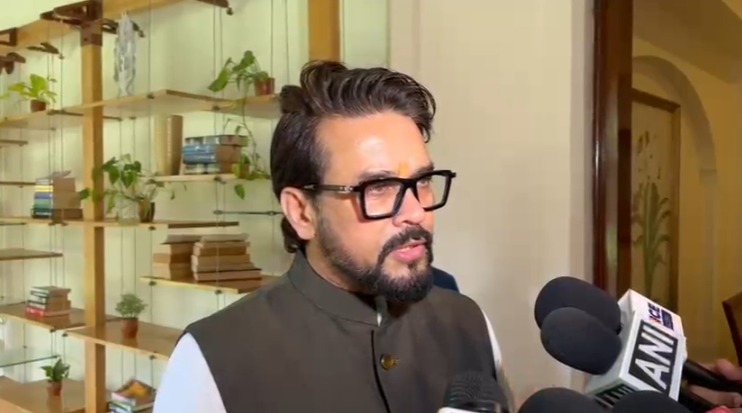
Panaji: BJP MP Anurag Thakur on Friday said the proposed “One Nation, One Election” reform could prove to be a “game-changing law” for the country, asserting that simultaneous polls would improve governance, attract investments, and generate more employment by reducing the time and resources spent on frequent elections.
Thakur, a member of the Joint Parliamentary Committee (JPC) examining the Constitution (One Hundred and Twenty-Ninth Amendment) Bill, 2024, was speaking to reporters after the committee held consultations with stakeholders in Goa on the first day of its two-day visit.
Drawing a parallel with the rollout of the Goods and Services Tax (GST), he said the country had benefited from the “One Nation, One Tax” reform and that the committee was now examining the likely impact of “One Nation, One Election” through consultations across states.
“This exercise has been a very enriching experience because we are discovering several issues that were not apparent earlier. Many of the adverse effects of frequent elections are not direct, but their indirect impact is substantial,” Thakur said.
The MP said that when all these aspects are assessed and reflected in the committee’s final report, he believes everyone will be surprised by the enormous benefits that “One Nation, One Election” can bring to the country.
“It could be a game-changing law for the country,” he commented.
“The committee is interacting with elected representatives, political parties, bureaucrats, lawyers, members of the judicial fraternity, public sector bodies, banks, and other institutions to understand the benefits and concerns associated with simultaneous elections,” he said.
Thakur said Goa had made a “very good presentation” before the committee, with Chief Minister Pramod Sawant and senior officials explaining how repeated elections affect governance even in a small state.
“If a small state like Goa experiences such a significant impact because of frequent elections, one can imagine the effect on larger states and the country as a whole,” he said.
“If we look at it from the perspective of national interest, this is a very significant decision—one that rises above individual and party interests. Today, India has an opportunity, as countries across the world are looking towards India with hope and expectation,” he said.
Thakur said that the more effective governance becomes and the more investment India attracts, the greater the opportunities for employment and self-employment. He added that the less time spent conducting elections, the more time governments would have to deliver justice and better public services to the people.
Thakur said repeated elections have a bearing on state revenues, government functioning, delivery of justice, education, and healthcare, adding that the committee was also identifying indirect impacts that often go unnoticed.
“The study tour is giving us valuable ground-level information, which will help the committee prepare its final report. When the assessment is completed, people will be surprised by the scale of benefits that One Nation, One Election can bring,” he said.
The former Union minister said the committee would next travel to Lucknow in Uttar Pradesh to continue consultations with the state government, opposition leaders, political parties, officials, and representatives of public and private sector institutions.
Describing the proposed reform as a decision that should be viewed in the national interest rather than through the prism of political or party interests, Thakur said greater efficiency in governance would help attract more investment and create employment opportunities.
“The less time governments spend conducting elections, the more time they will have to deliver justice and public services,” he said.
Thakur said the committee was making efforts to hear the views of all political parties, irrespective of their size, with stakeholders being invited to make oral presentations or submit written representations.
“Everyone has the right to express their views in a democracy. That is the strength of our democratic system — discuss, debate, and decide,” he said.

