

By: Adv. Vinayak (Mama) D. Porob
Dreams have fascinated human beings since the dawn of civilisation. Even today, when science has given us remarkable insights into the human brain, dreams remain one of its most mysterious experiences. In the Indian spiritual tradition, dreams have never been viewed merely as random images appearing during sleep. They have often been understood as reflections of thoughts, emotions, memories, desires, and fears, while certain dreams are traditionally believed to carry spiritual messages, warnings, or auspicious indications. This ancient understanding of dreams is broadly known as Swapna Shastra or Swapna Vichar.
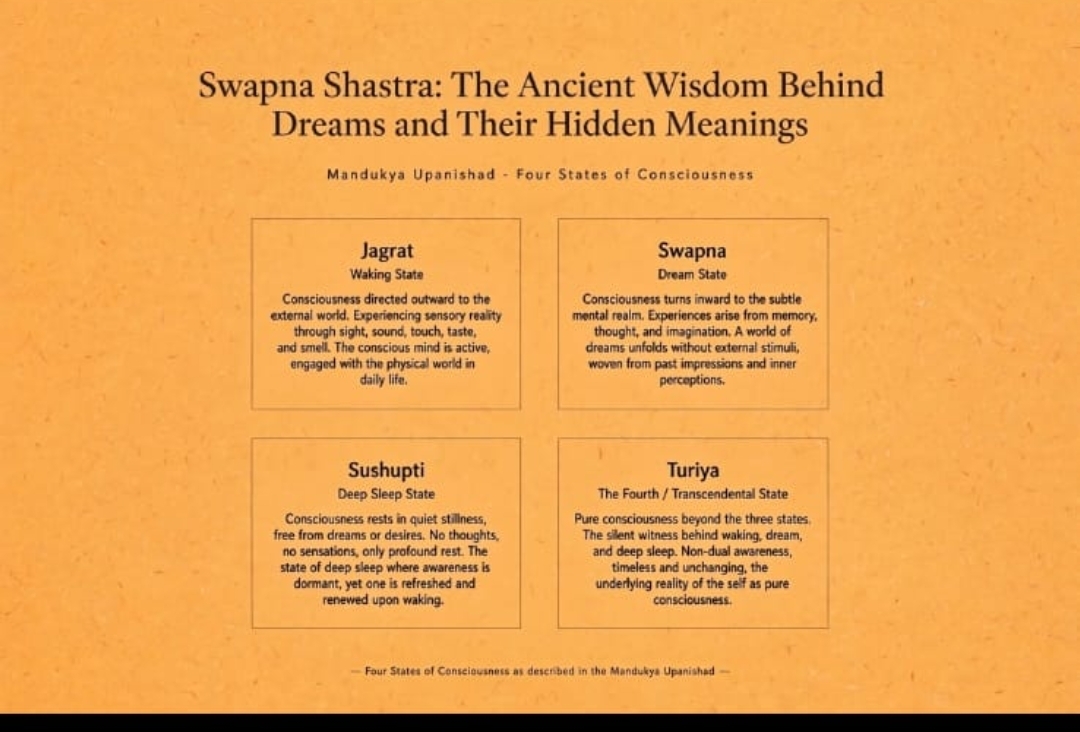
The significance of dreams can be understood through the ancient concept of different states of consciousness. The Mandukya Upanishad describes four states, namely Jagrat, Swapna, Sushupti, and Turiya. Jagrat is the waking state in which a person experiences the external world through the senses. Swapna is the dream state in which the external senses rest, but the mind creates its own inner world. Sushupti is deep, dreamless sleep, while Turiya represents a higher state of consciousness that remains the silent witness of the other three. In this philosophical framework, the dream state is not insignificant; it provides an intriguing window into the workings of the mind and consciousness.
Traditional Indian thought also recognises that not all dreams arise for the same reason. Some dreams are connected with things seen during the day and are traditionally called Drishta. Dreams arising from things heard are associated with Shruta. Those connected with personal experiences and emotions are described as Anubhuta. Dreams arising from intense wishes or desires are known as Prarthita, while imaginative or fanciful dreams are described as Kalpita. Traditional texts also speak of Bhavika dreams, which are considered prophetic in nature, and Doshaja dreams, which may arise from physical conditions or disturbances in the body.
One of the most fascinating elements of Swapna Shastra is the importance traditionally given to the timing of dreams. Dreams seen in the early part of the night are often considered more likely to be influenced by the day’s thoughts, conversations, and experiences. Dreams occurring during the latter part of the night are traditionally given greater significance, particularly those experienced close to dawn or during Brahma Muhurta. Such dreams are sometimes believed to have a stronger spiritual or symbolic character. However, different traditions offer varying interpretations regarding the timing and fulfilment of dreams, and these beliefs should be understood as part of traditional wisdom rather than as absolute rules.
Swapna Shastra also gives symbolic significance to many images that appear in dreams. Seeing a temple, deity, or spiritual teacher is traditionally considered auspicious and may symbolise divine protection, spiritual growth, or blessings. Clear, flowing water or a river may represent purification, peace, progress, and positive changes in life. A cow, white elephant, or white horse is traditionally associated with prosperity, good fortune, family happiness, and social respect. Climbing a mountain or a tall tree may symbolise ambition, advancement, achievement, and the ability to overcome obstacles. Similarly, seeing milk overflowing from a vessel is traditionally regarded as a symbol of abundance, prosperity, or good news.
There are also dreams that traditional interpretations regard as less favourable. Falling from a height may symbolise anxiety, insecurity, or a feeling of losing control. Being lost in darkness may reflect uncertainty about the future, while frightening or disturbing dreams may indicate fear, stress, or unresolved emotional concerns. Such dreams should not, however, be interpreted literally. A frightening dream does not necessarily mean that an unfortunate event is about to happen. Very often, the mind uses symbols to express emotions that may remain hidden during waking hours.
Traditional wisdom also suggests simple ways of dealing with disturbing dreams. Upon waking from a frightening dream, a person may remember their Ishta Devata, offer a prayer, recite a suitable mantra, or spend a few moments in meditation. Some traditions recommend chanting the Maha Mrityunjaya Mantra. Charity, feeding the needy or animals, and beginning the day with positive thoughts are also regarded as beneficial practices. The purpose is not merely to remove the supposed effect of a dream but also to prevent fear and negativity from influencing the mind.
At the same time, Swapna Shastra should be approached with balance and discernment. Human beings dream for many reasons. Daily experiences, memories, emotions, physical conditions, desires, fears, and even ordinary conversations can influence dreams. Therefore, every dream cannot be treated as a prophecy, and no important decision should be based solely on a dream. Traditional interpretation itself requires consideration of the circumstances, the dreamer’s state of mind, and the nature of the dream.
Perhaps the deeper beauty of Swapna Shastra lies not in its promise to predict the future but in its invitation to understand the self. A dream can reveal an unspoken fear, revive an old memory, express a hidden desire, or provide a feeling of spiritual reassurance. It may sometimes appear mysterious, but it can also be a mirror in which the inner world of a person briefly becomes visible.
Ultimately, dreams should be received with curiosity, faith, and wisdom, but also with discernment and sound judgment. A pleasant dream may inspire hope, while a disturbing dream need not create fear. Dreams may offer symbols, reflections, and, according to traditional belief, occasional signs of what may lie ahead. Yet life must always be guided by reason, experience, values, and conscious choice. The enduring message of Swapna Shastra is therefore simple and profound: sometimes, when the world outside becomes silent, the mind speaks in symbols, and listening carefully may help us understand ourselves a little better.
Disclaimer
The views expressed in this article are my personal opinions based on my understanding of traditional beliefs and my interpretation of Swapna Shastra. They are not intended to be treated as scientific facts or definite predictions of future events. Readers are advised to use their own discernment and judgment.

