

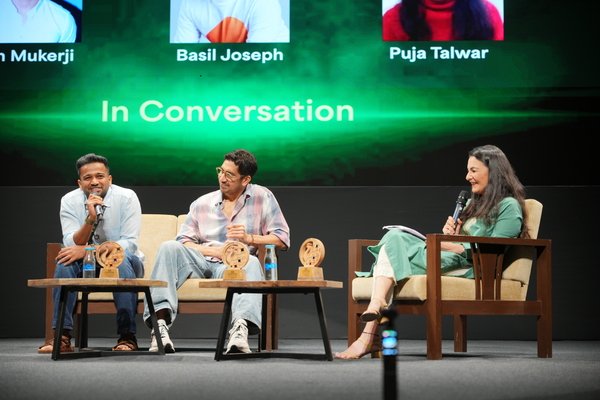
The extraordinary possibilities of mythology, superheroes and fantastical worlds, rooted in India’s rich cultural heritage, took centre stage at an engaging In-conversation session titled ‘The Epic Genres – Mythologies, Superheroes & New Worlds’ at the 57th International Film Festival of India (IFFI) in Goa. Filmmakers Ayan Mukerji and Basil Joseph, in a conversation moderated by Puja Talwar, explored the creative challenges of bringing superheroes and mythological narratives to the screen, the influence of Indian folklore and spirituality, and the evolving role of technology in cinematic storytelling.
Speaking about the challenges of making superhero films in India, Basil Joseph observed that Indian cinema has traditionally portrayed its leading men as larger-than-life figures, often possessing qualities associated with superheroes. This makes creating a distinct superhero cinematic universe particularly challenging. Reflecting on his film Minnal Murali, he explained how creative challenges, and budgetary constraints too, can inspire inventive storytelling. Scenes featuring a superhero running with a lungi covering his face and wearing chappals in the movie Minnal Murali emerged from such considerations.
Ayan Mukerji shared that the idea of extraordinary powers residing within ordinary people was what initially attracted him to the superhero genre. Discussing the challenge of creating an Indian identity for films that draw inspiration from Western fantasy, he acknowledged that Brahmastra initially carried certain Western influences, partly because of his admiration for stories such as Harry Potter. However, incorporating elements of spirituality into the writing helped give the film its distinct Indian identity.
Emphasising the importance of authenticity in filmmaking, Basil Joseph said that filmmakers must remain true to their characters and themselves rather than attempting to make their films appear artificial. He stressed that simplicity and creative honesty are essential, adding that one should never compromise one’s own identity in the pursuit of making a film look ‘cool’.
 Recalling the making of Brahmastra, Ayan Mukerji described the film as a logistically challenging undertaking. He noted that working within restrictions often pushes filmmakers to think beyond conventional approaches and discover more imaginative solutions. Creative challenges, he observed, can become catalysts for innovation rather than obstacles.
The conversation also explored India’s deep-rooted relationship with mythology and folklore. Basil Joseph observed that Indian audiences have grown up listening to stories of divine beings and extraordinary powers. Unlike the West, where mythological superheroes are relatively less pervasive in popular storytelling, India has a vast tradition of divine figures who appear to protect and rescue people in times of distress. With an immense reservoir of mythological and folkloric references, filmmakers naturally draw upon stories and experiences absorbed during childhood while creating cinematic worlds.
Ayan Mukerji highlighted how technological advancements have expanded the possibilities of visual storytelling, enabling filmmakers to bring ambitious narratives and fantastical worlds to life. He noted that mythology has always been a constant presence in Indian storytelling, with technology now providing new avenues to present these age-old narratives to contemporary audiences.
Sharing his perspective on the future of filmmaking in the age of Artificial Intelligence, Basil Joseph observed that AI primarily reproduces existing content rather than creating something truly original. He underlined that originality would become increasingly valuable in an era where technology can replicate creative material with ease.
The speakers also discussed how the growth of OTT platforms has transformed the reach of Indian cinema. Basil Joseph pointed out that films made in one language are now finding appreciation across different regions of the country, with audiences able to experience them in their own languages. This growing accessibility, he noted, has opened new avenues for regional cinema to connect with audiences beyond linguistic boundaries.
The conversation offered valuable insights into the evolving landscape of Indian films in the genre, highlighting how technological possibilities, creative ingenuity and an enduring connection with indigenous mythology can come together to create cinematic worlds that are both imaginative and distinctly Indian.

