

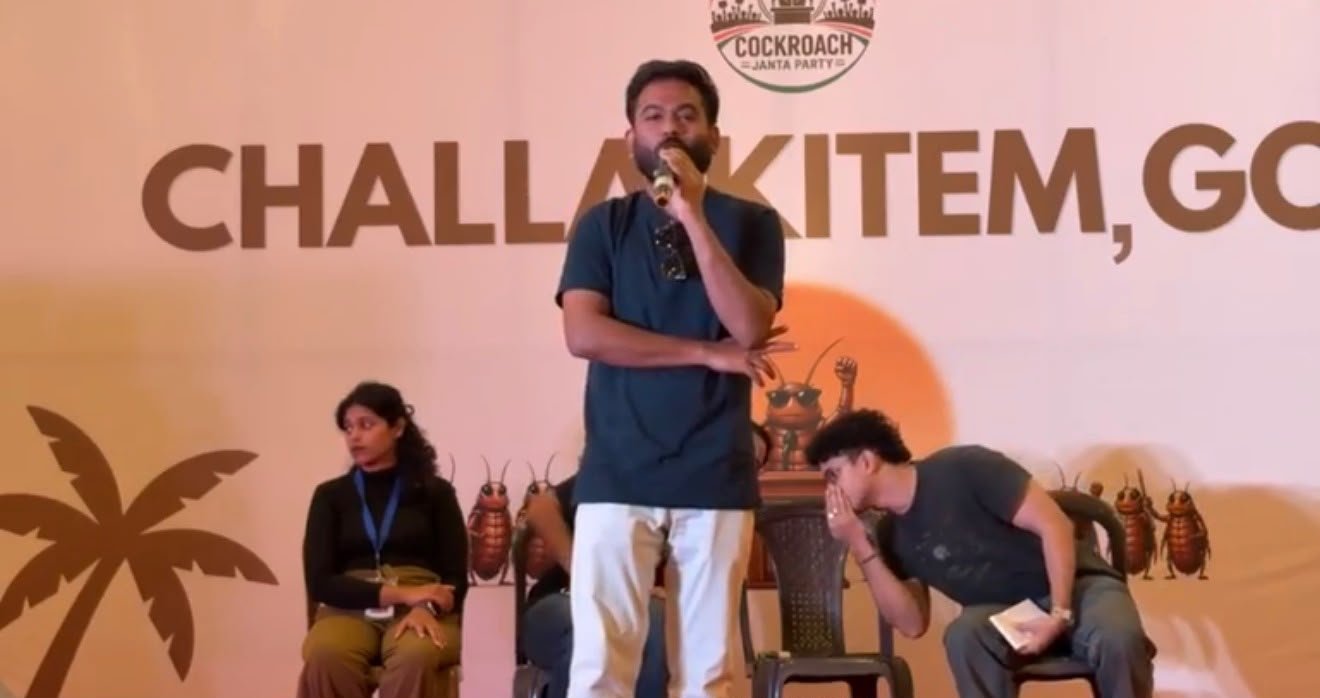
Panaji: Cockroach Janata Party (CJP) National Convenor Abhijit Dipke on Sunday called for citizens across the country to rise above religious and caste identities and focus on issues affecting their daily lives, alleging that political forces were using social divisions to divert attention from governance and accountability.
Addressing a gathering in Panaji in the presence of Saurav Das and Ashutosh Ranka, Dipke said CJP was committed to bringing people together and reclaiming India’s social fabric, which he said was rooted in the ideals of Mahatma Gandhi, Jawaharlal Nehru and B R Ambedkar.
“Citizens should always maintain their ability to think as citizens. When they take away that ability and force you to think as a Hindu, Muslim or Christian, you stop focusing on the real issues that affect your daily livelihood. You stop questioning the government, which is responsible for those issues,” he said.
Alleging that people were being divided along religious and caste lines to help political parties remain in power, Dipke said CJP wanted to unite citizens irrespective of their religion, caste, creed or political ideologies.
“CJP is here to unite India. CJP is here to reclaim the very social fabric of India, which was based on the ideas of Mahatma Gandhi, Pandit Jawaharlal Nehru and Dr Babasaheb Ambedkar,” he said.
The CJP leader also questioned what he described as the erosion of democratic principles, referring to the political developments in Goa in 2017, when several Congress MLAs joined the BJP after the Assembly elections.
“Today, everybody is talking about vote theft. In Goa, they stole MLAs. It started with the stealing of MLAs in Goa, which has now led to the issue of vote theft,” he alleged.
Questioning the constitutional propriety of such political developments, Dipke said those accusing CJP of being unconstitutional should explain how elected representatives switching parties to help form governments could be justified.
“We are not here to get into power. We are not here to make any party win. What we really want to achieve is an India where Hindus, Muslims and Christians live together and everybody can practise their faith without any discrimination,” he said.
While outlining the party’s national objectives, Dipke also raised concerns over land ownership, environmental degradation and development projects in Goa.
Alleging that politicians and builders were working together to take over land belonging to local communities, he said land acquisition and large-scale construction could eventually threaten Goa’s traditions, culture and identity.
Referring to a proposed 130-acre township project in Karapur, he questioned the priority being given to luxury developments over essential infrastructure such as schools, colleges and hospitals. He also raised concerns over water scarcity in the area, alleging that the project could put additional pressure on groundwater resources.
Dipke demanded that Section 39A be scrapped, claiming that it threatened the land rights of Goans. He appealed to civil society groups and members of the legal fraternity to join the campaign against the provision.
He also alleged that Goan youth were not receiving an adequate share of the benefits generated by the state’s tourism industry and said local youth should be given priority in tourism-related businesses and employment.
Recalling the solidarity shown by people in Goa during protests at Jantar Mantar in New Delhi, Dipke said citizens should stand up against injustice even when the affected people were strangers to them.

