

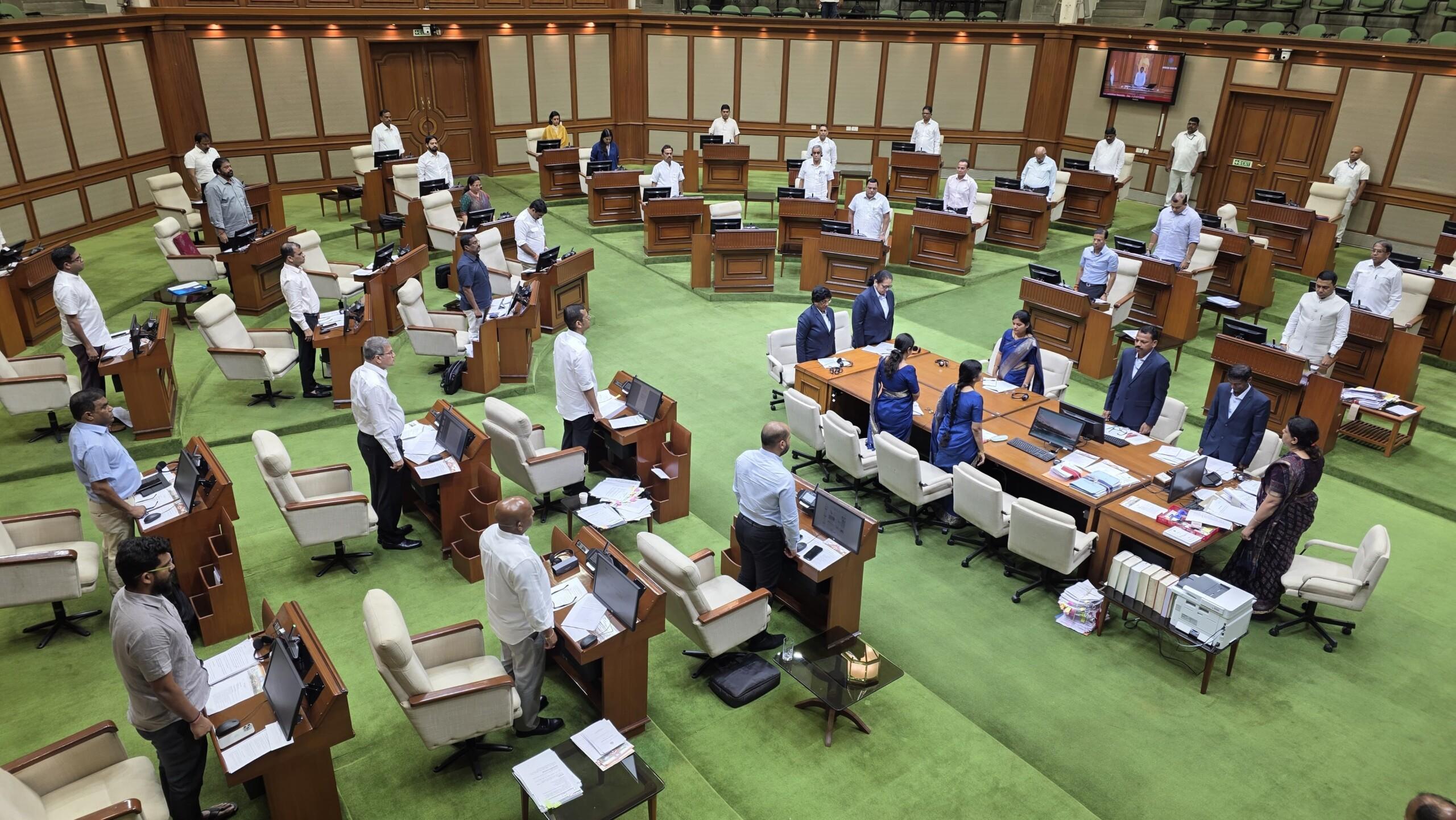
Panaji: The Goa Legislative Assembly on Thursday passed the Goa Land Revenue Code (Amendment) Bill, 2025, enabling regularisation of unauthorized dwelling houses built before February 28, 2014, on the state government land.
The bill, moved by Revenue Minister Atanasio Monserrate during the ongoing monsoon session, seeks to insert a new section — 38A — into the Goa Land Revenue Code, 1968, empowering the Deputy Collector to regularise such encroachments and confer Class I occupancy to eligible applicants.
The Bill was passed on Thursday evening on the floor of the House amidst debate from the opposition, who feared that this legislation will benefit the non-Goans.
As per the Bill, the regularisation of structure is subject to payment of an occupancy price, which will be notified separately by the government.
As per the Bill, the regularisation of structure is subject to payment of an occupancy price, which will be notified separately by the government.
“It applies only to landless Goan residents who have lived in the state for at least 15 years prior to the cut-off date and who do not own any other land, house, flat, or ancestral share in property,” the chief minister Pramod Sawant told the House.
However, the Bill excludes lands falling within protected forests, wildlife sanctuaries, coastal regulation zones, eco-sensitive zones, Khazan lands, road setbacks, and natural water channels Sawant explained that such structures will not be covered under the purview of this Bill.
However, the Bill excludes lands falling within protected forests, wildlife sanctuaries, coastal regulation zones, eco-sensitive zones, Khazan lands, road setbacks, and natural water channels Sawant explained that such structures will not be covered under the purview of this Bill.
The maximum area eligible for regularisation is capped at 400 square meters, which includes the plinth area and a two-meter buffer around the house, if available. Any encroached area beyond the prescribed limit must be surrendered to the government as a precondition for regularisation.
The Bill mandates that applicants must file for regularisation within six months of the Act’s notification, and the Deputy Collector is required to dispose of such applications within another six months.
The legislation also imposes a 20-year restriction on the sale or transfer of the regularised property, except by gift to a family member which is regularised under this Bill.
“Any false declaration by applicants may lead to cancellation of the regularisation, penal action including imprisonment up to two years, and a fine of up to Rs one lakh,” the legislation mentions.
“Any false declaration by applicants may lead to cancellation of the regularisation, penal action including imprisonment up to two years, and a fine of up to Rs one lakh,” the legislation mentions.
The Bill aims to provide tenure security to long-time occupants while also curbing large-scale encroachments and augmenting state revenue, as per the Statement of Objects and Reasons.
There are no financial liabilities to the state under the Bill, although it is expected to generate revenue through the occupancy price.

