

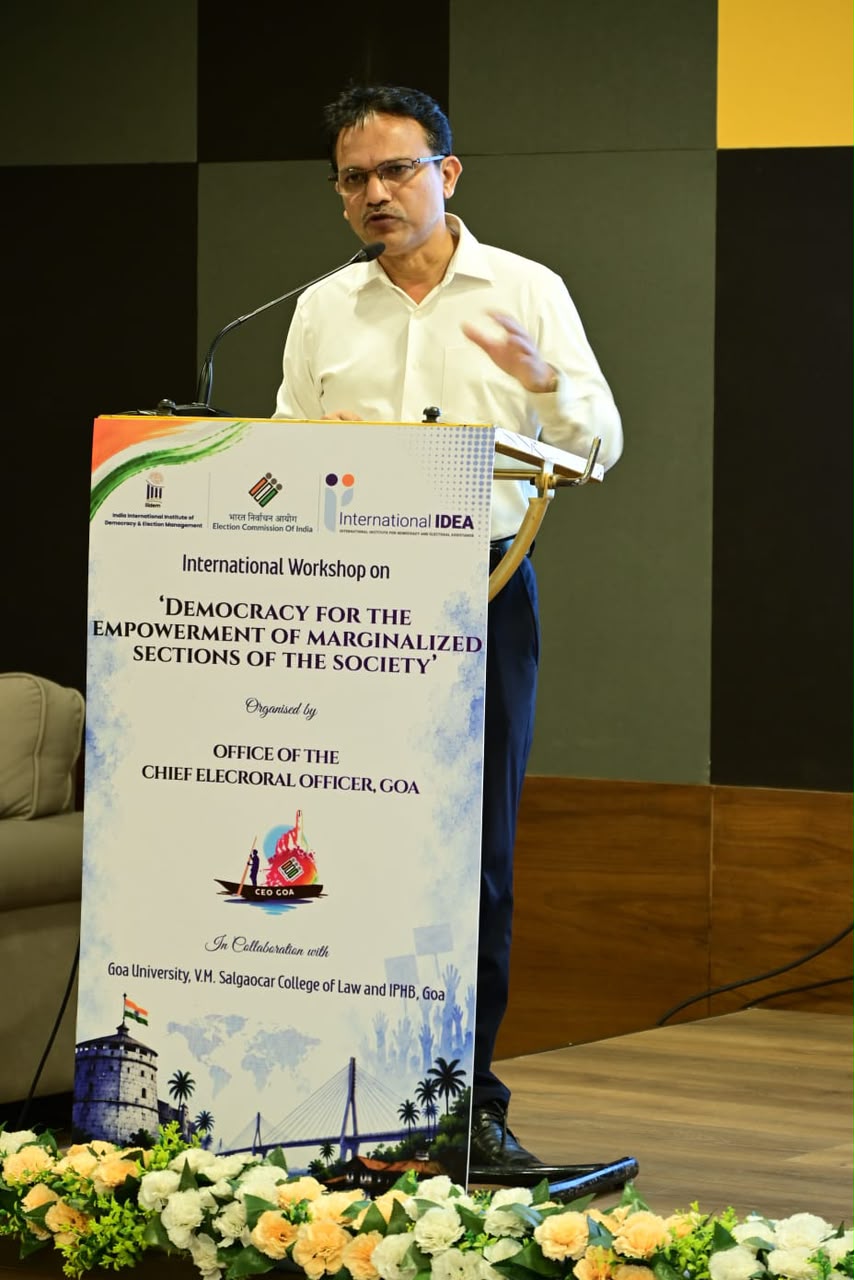
Panaji, August 11, 2026: The need to make democracy more inclusive by ensuring that persons with disabilities are able to participate fully in public life was highlighted at the International Workshop on “Democracy for the Empowerment of Marginalized Sections of Society”, organised by the Office of the Chief Electoral Officer, Goa, in collaboration with Goa University, V.M. Salgaocar College of Law, and IPHB Goa.
The chief guest for the workshop was Padma Shri and Arjuna Awardee Brahmanand Sankhwalkar. The keynote speaker was eminent political scientist Professor Peter de Souza, former Director of the Indian Institute of Advanced Study (IIAS), Shimla.
Speaking during Technical Session II on “Democracy for the Empowerment of Marginalized Sections of Society”, State Commissioner for Persons with Disabilities Guruprasad R. Pawaskar emphasised that empowerment cannot be limited to welfare measures but must include the right of persons with disabilities to participate equally in education, employment, public spaces, governance, and decision-making.
The session was chaired by Sudesh Nanda Gaude, Associate Professor of Psychiatric Social Work, alongside speakers Guncha Batra of IIIDEM, New Delhi; Dr. Alaknanda Shringare of Goa University; Dr. Sachin Tendulkar, CEO of the Mineral Foundation of Goa; Dr. Vasudha Sawaikar of Goa University; and Taha Haaziq, Secretary, Office of the State Commissioner for Persons with Disabilities.
Pawaskar said, “A democracy cannot be truly inclusive if a section of its citizens continues to face barriers in exercising their basic rights. For persons with disabilities, empowerment means more than access to schemes—it means having the freedom, opportunity, and support to participate as equal citizens in society.”
He stressed that accessibility must be viewed as a fundamental component of democratic governance rather than as an additional facility. He pointed to the need for accessible public infrastructure, transport, information, and communication systems to enable persons with disabilities to participate independently in everyday life.
“We need to move from a mindset of providing facilities for persons with disabilities to creating systems that are designed with their participation in mind. Accessibility should not be an afterthought; it must be built into the way we plan our cities, institutions, transport systems, and public services.”
The issue has particular relevance in Goa, where efforts are being made to improve accessibility. Recent initiatives include accessible transport and efforts to create barrier-free public infrastructure. At the same time, concerns have been raised over accessibility in public transport and the implementation of disability rights in public spaces.
Pawaskar also highlighted the importance of political and civic participation, stressing that persons with disabilities should not merely be beneficiaries of government programmes but active participants in shaping policies that affect their lives.
“Nothing about persons with disabilities should be decided without persons with disabilities being part of the conversation. Their lived experiences must inform policy, planning, and governance. That is what meaningful participation in a democracy looks like.”
He said that inclusion must also extend to employment and education.
The State Commission has recently supported initiatives to help persons with disabilities access competitive examination coaching, including accessible study material, sign-language interpretation, and assistive technology.
“If we want empowerment, we must create pathways to opportunity. A person with a disability should not be prevented from entering public service or pursuing a career because the system was not designed to accommodate them. Equal opportunity requires us to remove those barriers,” Pawaskar said.
The workshop brought together stakeholders to examine how democratic institutions can better respond to the needs of marginalised communities and strengthen participation, representation, and social justice.
It explored how democratic systems can serve as powerful mechanisms for empowering marginalized sections of society, creating space for voices historically excluded based on caste, ethnicity, gender, disability, class, geography, or other forms of disadvantage. The workshop focused on how inclusive institutions—through voting rights, representation, constitutional guarantees, and participatory platforms—enable marginalized groups to influence decisions, challenge entrenched hierarchies, and share in political power.

