

By Dr. Sonia Mukesh Desai
Librarian
SWAmi Vivekanand college of Commerce, Bori
The day after Diwali, when the lamps have burned low and the crackers have fallen silent, many Goan villages turn from the festival of lights to a quieter and older tradition: Gorvancho Padwo, the festival of cattle. In several villages the day also brings Dhendlo, a procession in which Lord Krishna is carried from house to house to the sound of drums and song.
Padwo is, at heart, a day of gratitude. For generations Goan farmers have depended on their cows and bullocks to plough the fields and bring in the harvest. On this day the animals are honoured. Cattle sheds are cleaned and decorated, and each cow is worshipped, with kumkum applied to its forehead and a garland of flowers placed around its neck. Families offer prasad, including puffed rice, rice dosas and podey. In some villages, a miniature cowshed made of cow dung is built in the courtyard in front of the Tulsi Vrindavan.
In Ponda, villagers have been reported to make a Krishna figure from hay and leaves, to use the karit fruit (muskmelon) to stand for the cows, and to display small replicas of cooking utensils made of cow dung in the cowshed.
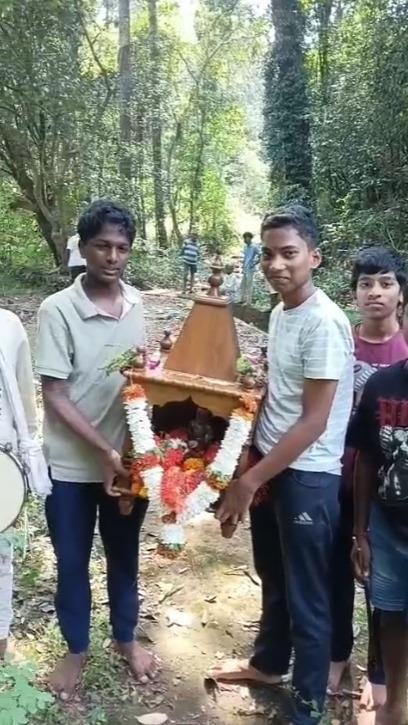
In some villages, Dhendlo is carried out by the village’s tribal and farmer communities on the day of Gorvancho Padwo. The Dhendlo is an idol of Lord Krishna, placed in a square, box-like shrine similar to a devaro, which a man carries on his head. Krishna is remembered here as the friend of the cowherds, the Gopala, which is why he is so closely tied to a festival of cattle.
The bearer walks through the village visiting every household, accompanied by dhol and taashe. At each house, the woman of the family washes his feet. Families welcome the procession with flowers and offerings of farm produce such as rice or coconut. In Sanvordem, young people carry the devaro from door to door, keeping the tradition alive for a new generation.
As the procession moves from house to house, the villagers sing:
Dhendlo ata paus shenlo.
Dhenlyachi mhatari shede unne khatali,
de dhenlo dhenlya paus shenlo.
Villagers explain the refrain as a farewell to the monsoon. By the time of Diwali the rains have usually ended and the harvest is in, so Dhendlo marks the end of the rainy season and the start of the dry months.
Fewer families keep cattle today than in the past, and some of these customs are less visible than they once were. Yet Dhendlo continues in village after village, carried on by neighbours and by young people. It is a community festival in the full sense: it asks everyone to step outside, greet one another, and give thanks to the animals and the land that sustain them.

