

By Adv. Vinayak D. Porob
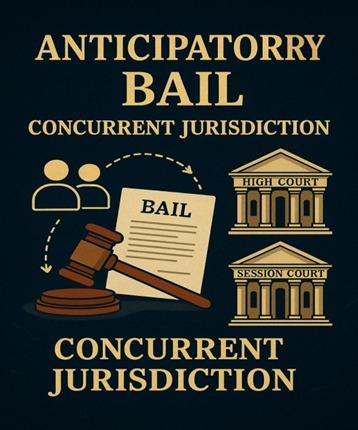
Although the statutory framework confers concurrent jurisdiction upon both the High Court and the Court of Sessions to entertain applications for pre-arrest bail under Section 438 of the Code of Criminal Procedure, 1973 (now re-enacted as Section 482 of the Bharatiya Nagarik Suraksha Sanhita, 2023), it has been opined that, as a matter of judicial propriety, procedural discipline, and institutional hierarchy, the Court of Sessions should ordinarily constitute the first forum of recourse.
While both forums are vested with co-extensive authority, it has been underscored that the jurisdiction of the High Court in matters of anticipatory bail ought to be invoked only in exceptional and extraordinary circumstances. The principle of concurrent jurisdiction does not imply the unfettered liberty to bypass the Sessions Court and directly approach the High Court.
It has been delineated that an individual apprehending arrest may directly approach the High Court under Section 438 CrPC or Section 482 BNSS only in narrowly defined exceptional situations, such as:
(a) Where an accused not ordinarily residing within the territorial jurisdiction of the Sessions Court and/or the High Court concerned is apprehending arrest;
(b) Where the situation within the jurisdiction of a Sessions Court is such that a person cannot effectively seek redressal before the Sessions Court, such as on account of local law and order disturbances, strikes, hostility against the individual, reasonable apprehension of grievous or other bodily harm to the person of the individual and/or their family members, and so on;
(c) Where the accused can make out their inability to approach the Sessions Court because of medical or other emergencies of a similar nature; and
(d) Where the court of first jurisdiction under Section 438 CrPC / Section 482 BNSS is a special or designated court of the rank of an Additional Sessions Judge or Sessions Judge dealing with a special or local law.
It has been observed that although both the High Courts and the Sessions Courts are statutorily conferred with concurrent powers, the Sessions Court should be regarded as the primary and natural forum for the initial invocation of jurisdiction. The practice of directly moving the High Court without first invoking the Sessions Court’s jurisdiction has been viewed as inconsistent with legislative intent and deleterious to the structural integrity of the judicial hierarchy.
India’s diverse geographical expanse and multi-tiered judicial structure necessitate a framework that facilitates access to justice rather than centralising judicial recourse within High Courts located in capital cities. The concurrent conferment of jurisdiction upon both forums was intended by Parliament to promote accessibility and not to weaken the authority or relevance of the subordinate judiciary. Any procedural prescription governing the choice of forum must therefore be interpreted through the constitutional prism of accessibility, efficiency, and fairness.
The proposition that the Sessions Court should have primacy in anticipatory bail matters rests not upon subordination but upon institutional prudence and functional coherence within the judicial system. Fortifying the district judiciary is indispensable to enhancing public confidence in the justice delivery system, and Sessions Courts, being geographically closer and economically more accessible, provide the most practical avenue for the common litigant.
In contrast, the growing tendency in certain jurisdictions where High Courts routinely entertain anticipatory bail petitions at the first instance has led to docket congestion and undermined the perceived competence of subordinate courts. It has been cautioned that such a practice fosters a misconceived perception that Sessions Courts are less competent or incapable of granting anticipatory bail, thereby disturbing the judicial hierarchy and weakening institutional balance.
A cautious and calibrated approach has therefore been recommended—one that preserves the possibility of direct recourse to the High Court in genuine cases of necessity but discourages its indiscriminate invocation. An underlying rationale is that a harmonised and balanced judicial framework must prevail to preserve statutory concurrency while encouraging judicial restraint in its exercise.
This philosophy mirrors the constitutional practice under Articles 32 and 226 of the Constitution of India, wherein superior courts, though possessing concurrent powers, ordinarily direct litigants to first exhaust more accessible and efficacious remedies. Various High Courts across the country have adopted divergent interpretations regarding the necessity of approaching the Sessions Court before invoking the High Court’s jurisdiction in anticipatory bail matters. This divergence underscores the need for uniform judicial guidance and doctrinal consistency across jurisdictions.
This issue of forum hierarchy and procedural propriety in anticipatory bail applications has been comprehensively examined and considered in Mohammed Rasal C & Anr. v/s State of Kerala & Anr. The forthcoming adjudication in the matter is anticipated to crystallise the legal contours of concurrent jurisdiction under Section 438 CrPC and Section 482 BNSS, thereby providing definitive guidance for uniform judicial practice and ensuring the harmonious functioning of both forums within the criminal justice system.
Author’s Note: This article represents the personal opinion of Advocate Vinayak D. Porob and is based on his independent interpretation of the provisions of the Bharatiya Nagarik Suraksha Sanhita, 2023, and the Constitution of India in the matter concerning concurrent jurisdiction in anticipatory bail.

