

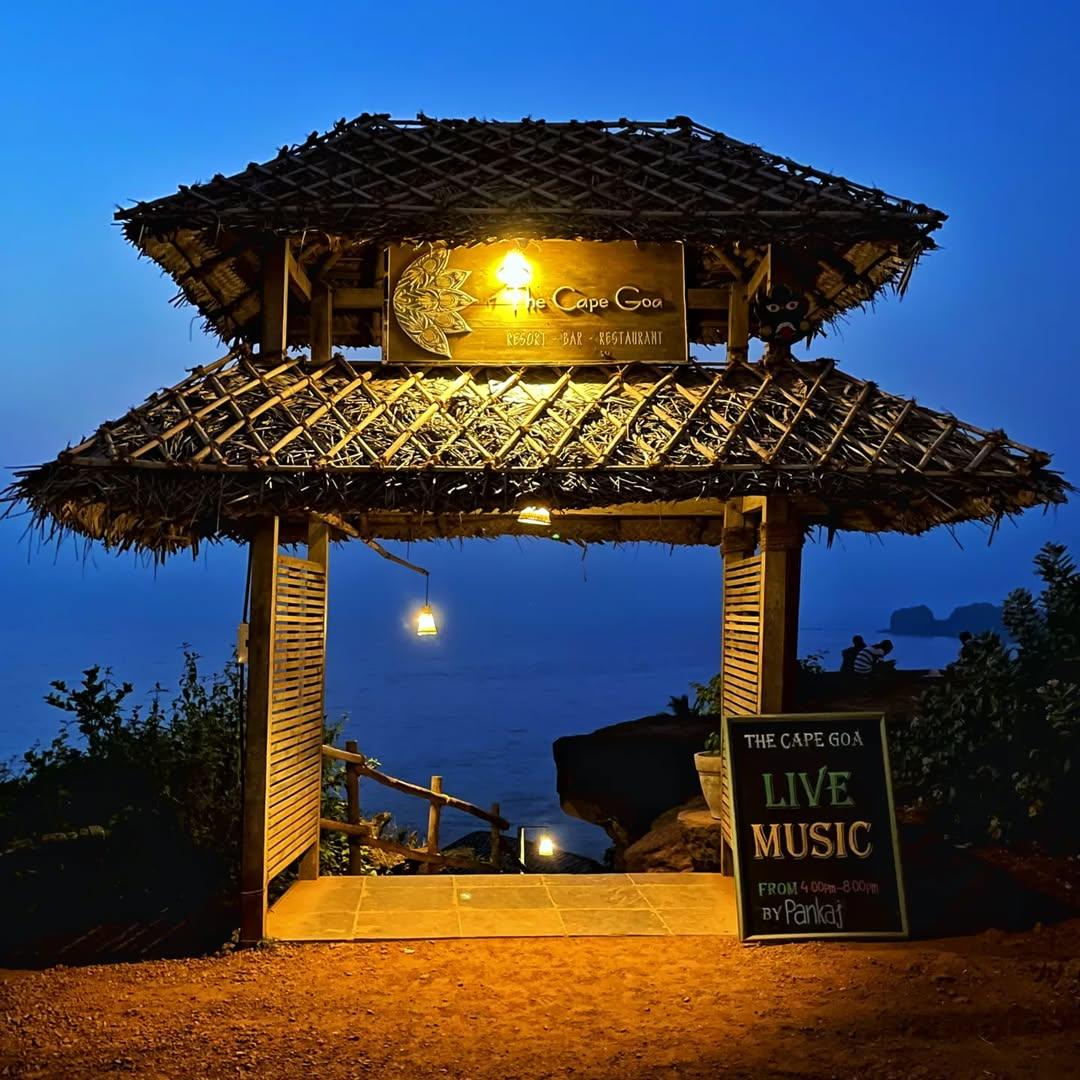
Panaji: State authorities on Monday directed the sealing of the prominent cliffside restaurant, The Cape Goa, located at Cabo de Rama Fort in Kuddi village, South Goa, for various violations.
Chairperson of the Joint Enforcement and Monitoring Committee, Canacona taluka, Maya Pednekar on Monday issued an order to seal The Cape Goa restaurant situated on a cliff at Cabo de Rama Fort.
An inspection of the premises was carried out on December 12 by a team led by Pednekar, during which several violations were noticed at the well-known restaurant.
The action follows the fire tragedy at an Arpora nightclub that claimed 25 lives on December 6.
The sealing notice stated that there was an “imminent threat to human life and property.”
“Upon careful consideration of the inspection report and material placed before me, I am satisfied that the danger is real, proximate and imminent; the premises are being used in a manner endangering public safety; and immediate intervention is necessary in the interest of protection of human life and property,” the order stated.
During the inspection, the committee observed that the restaurant was being operated in gross violation of mandatory statutory safety requirements.
The order mentioned that the premises were overcrowded, accommodating more than 24 persons, far beyond permissible limits. No approved structural plan or structural stability certificate was produced. The kitchen was found to be unsafe, with no proper exit, and was operating with a high fire hazard risk.
“The pantry section had no exit, posing a serious safety hazard. A total of 29 commercial LPG cylinders were found stored in the open near the exhaust blower and duct, which is extremely unsafe. The absence of a designated LPG bank and non-installation of LPG gas leak detectors posed a serious and immediate fire and explosion hazard,” the order stated.
Pednekar stated that there was no separate exit provided from the restaurant area, while fire extinguishers and fire-fighting equipment were absent in the restaurant seating area, kitchen, staff pantry, storeroom, bakery, and an additional storeroom located below the restaurant.
“The kitchen area and movement and entry routes were obstructed, and cooking ranges were placed in movement areas. No clear signage indicating entry, exit, escape routes, or assembly points was displayed,” the order stated.
Further, the committee pointed out that the exit point was obstructed by 29 commercial LPG cylinders, and the MCB distribution board was found open and unsafe. Loose connections and joints were noticed, and the entire wiring was found to be dangerous.
The committee also observed that the Tourism Department had granted permission for one private temporary shack measuring 8×18 metres in Survey No. 269-2.
“However, it was observed that the establishment is operating a full-fledged restaurant beyond the sanctioned plinth area, with a bar counter, attached kitchen, bakery, pantry, staff mess with approximately 120 staff members, staff rooms in the basement, around 40 tables with an average seating capacity of 120 persons, housekeeping room, electrical room, feeding room, additional storage room, spa room, among others, which is far in excess of the capacity and area approved by the Tourism Department,” the order stated.
In a detailed order, Pednekar said that the continued operation of the premises without mandatory safety clearances posed an imminent, grave, and real threat to human life and property, particularly in the event of fire, electrical short-circuit, structural failure, or any emergency requiring evacuation.

